
VIP member
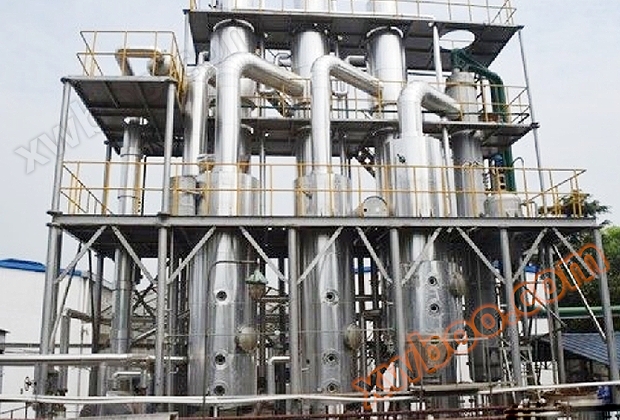
Evaporation concentration
Evaporation concentration is mainly used to concentrate the influent TDS to a certain concentration requirement, making other processes more economica
Product details
Evaporation concentration is mainly used to concentrate the influent TDS to a certain concentration requirement, making other processes more economical and reasonable. The degree of concentration is determined based on the treated water quality, water quantity, and production requirements. According to the different forms of input energy, evaporation systems can be divided into MVR, multi effect TVR、 Waste heat evaporation. This article takes MVR evaporator as an example for analysis:
Principle of MVR evaporator technology
After the secondary steam generated by the evaporator is compressed by the steam compressor, the low-grade steam is compressed to high-grade steam with a higher saturation temperature, and returned to the heating source for the evaporator, replacing the majority of the raw steam. The raw steam is only used to supplement the heat loss and the enthalpy required to supplement the temperature difference between the inlet and outlet, thereby reducing the consumption of raw steam in the evaporator and achieving energy-saving goals.
Advantages of MVR evaporator
1. High heat transfer coefficient: This type of evaporator structure has a variable flow field, making it easy for the liquid to reach a state of vigorous turbulence. Its heat transfer coefficient is 2-3 times that of a tubular evaporator;
2. Not easy to block: The material liquid forms a disturbance flow on the heat exchange surface, which can wash the heat exchange surface, causing the scaling bodies adhered to the heat exchange surface to fall off and delaying the scaling cycle;
3. The surface is very smooth: using mature processing technology, the surface roughness of the heat exchange surface is controlled at a very low value, making it difficult for pollutants to adhere. The scaling rate of this type of heat exchanger is only 1/5 of that of a tubular heat exchanger;
4. Easy to clean and repair: Adopting a plate structure, the heat exchange surface can be easily disassembled, and any contaminated or damaged heat exchange surface can be easily replaced.
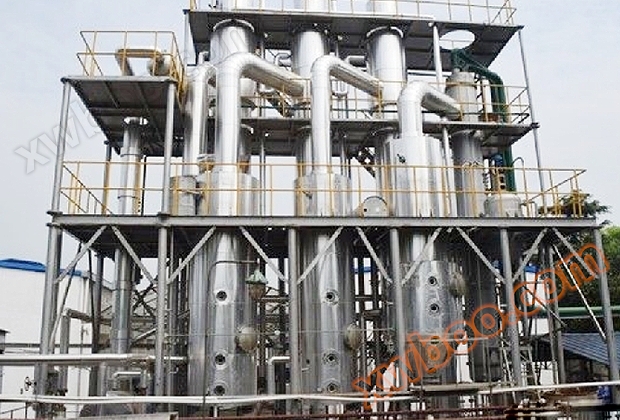
Scope of application:
Evaporation and crystallization of various inorganic salts, evaporation of materials with high hardness, evaporation and concentration of leachate from garbage, concentration of materials in the food, fermentation, and pharmaceutical industries, and concentration of thermosensitive materials.
Design considerations for MVR evaporator:
1. The water inlet conditions of MVR evaporator affect the process data and parameters of MVR evaporator. When designing the MVR evaporator, the process of the MVR evaporator will be customized according to the water quality of the owner.
2. The processing capacity and evaporation capacity of the material water quality determine the size of the MVR evaporator, and the water quality of the material determines the materials of the heat exchanger and evaporator, as well as the investment of the entire MVR evaporator.
3. The solubility and temperature rise of materials determine the selection of steam compressors in the MVR evaporator design scheme.
4. The production method on site determines the operation mode of the MVR evaporator. The operation mode of the entire MVR evaporator is to use continuous evaporation operation or intermittent evaporation operation, and the operation mode of the MVR evaporator should be determined according to the customer's production mode.
Principle of Multi effect Evaporator
From more primitive evaporation vessels, it has developed into single effect, double effect, triple effect, quadruple effect or more effect evaporators, all with the aim of gradually reducing energy consumption. A multi effect evaporator uses the secondary steam generated by the previous effect evaporation to provide a heat source for the next effect, in order to achieve energy conservation. Multi effect can recover some of the secondary steam, and the more effects there are, the more secondary steam can be recovered. This is different from MVR evaporators that can recover all secondary steam. Multi effect evaporation systems often consider recovering the heat from condensed water or secondary steam to achieve energy-saving goals. In wastewater treatment, automatic online cleaning of preheater fouling should also be considered.
Energy consumption of multi effect evaporator
Generally speaking, single effect evaporation consumes 1.1-1.2 tons of steam per ton of water, double effect evaporation consumes 0.6-0.7 tons of steam per ton of water, triple effect evaporation consumes 0.37-0.46 tons of steam per ton of water, quadruple effect evaporation consumes 0.3-0.35 tons of steam per ton of water, and quadruple effect evaporation consumes 0.24-0.3 tons of steam per ton of water.
Online inquiry
-
Contacts
-
Company
-
Telephone
-
Email
-
WeChat
-
Verification Code
-
Message Content
-